Agent + Specialized Skills Is All You Need
Every task is a software task. You just need the runtime to run it.Here's a simple idea: Agent + Skills = Any Task.
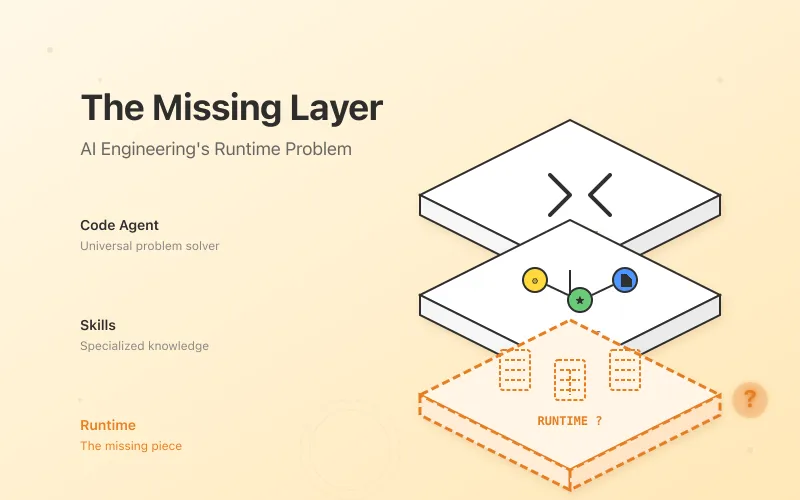
Not just software tasks. Any task. But there's a catch.
The Agent: A Universal Problem Solver
An agent is inherently generic. Give it any task, and it figures out how to solve it by writing and running code. Process a CSV? It writes a script. Call an API? It writes the integration. Generate a report? It builds the pipeline.
This universality is powerful. One agent can handle tasks that would normally require ten different tools. But generic also means starting from scratch every time. The agent doesn't know your company's data formats, your team's conventions, or your domain's edge cases.
Skills: Specialized Knowledge, Repeatable Results
A skill transforms a generic agent into a domain expert. It's a reusable prompt that encodes specialized knowledge - your proprietary data schemas, your company's workflows, your industry's best practices.
The more specialized the skill, the more useful it becomes. A generic "analyze data" prompt gives you generic results. A skill that knows your specific KPIs, your data sources, and your reporting format? That's a team member who never forgets.
Skills capture expertise without requiring you to maintain code. The agent does the work, the skill guides it with domain knowledge, and you get results tailored to your exact needs.
The Missing Piece: Runtime
You have the agent. You have the skills. Now where do you run them?
Traditional infrastructure wasn't built for this. A runtime for agents needs three things:
1. Run from Anywhere
Users should be able to run any agent and skill combination, from anywhere, at any time. Like serverless functions - you don't think about servers, you just invoke the agent and it runs. No setup, no provisioning, no waiting. The agent is always ready.
2. Isolation
Each agent needs its own isolated environment. When you run an agent, it shouldn't interfere with other agents - or be affected by them. Complete separation. Your agent's files, processes, and state are yours alone. This isn't just about security; it's about reliability. One agent crashing shouldn't take down another.
3. State Management
Here's where agents fundamentally differ from traditional services. A typical API request runs once and is destroyed. An agent? It might run for an hour. Or a day. Or a month.
Agents need to pause and resume. They need to survive disconnections. They need to pick up where they left off after a crash. The conversation history, the working files, the execution state - all of it needs to persist across sessions, not just within a single request.
This is the gap. We have frameworks to build agents, observability to trace them, evals to test them. But the infrastructure to actually run them at scale? That's been missing.
Agent + Skills + Runtime
That's what Rebyte provides. The runtime layer that turns agents into production services.
- Run agents as APIs - HTTP endpoints, not terminal sessions
- State management - sessions persist, context survives restarts
- Streaming - durable streams that handle disconnects gracefully
- Isolation - every task runs in its own sandbox, guaranteed separation
- Recovery - agent crashes? State is checkpointed, conversation resumes
Agent + Skills tells you what's possible. The runtime makes it actually work.
Every task is a software task. Now you have the infrastructure to run it.