Rebyte Is Not a Super Agent
The market is full of enterprise agent systems — vertical solutions and generic "do everything" platforms. Rebyte takes a different path: four fundamental primitives that anyone can understand and combine.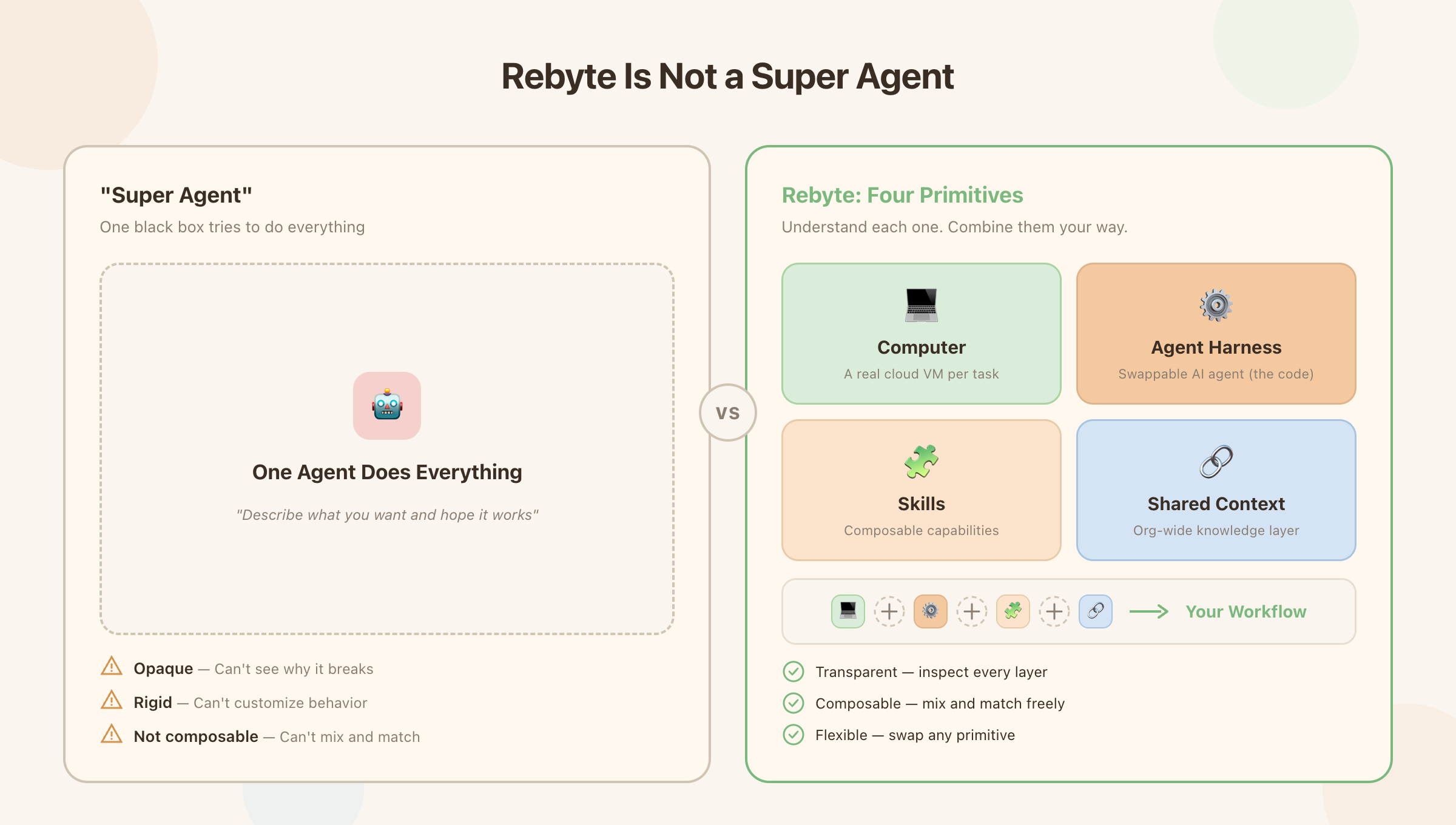
The market is flooded with enterprise agent systems. Some focus on verticals — agents for customer support, agents for sales, agents for code review. Others go generic — one agent to rule them all, just describe what you want and the system figures out the rest.
We think both approaches miss something fundamental.
Vertical agents are useful but narrow. You end up with a dozen different platforms, each handling one slice of your work, none of them composable. Generic "super agents" go the other direction — they promise everything, but the abstraction is so high that you lose control. When something breaks, you can't see why. When you need something slightly different, you can't build it. You're not using a tool. You're hoping the tool understands you.
Rebyte takes a third path.
Four Primitives
Instead of building a super agent that tries to handle every task, we expose four fundamental primitives. Each one maps to a concept that everyone already understands.
1. The Computer
Every task runs on a real, dedicated cloud machine. Not a container that vanishes. Not a serverless function with a 30-second timeout. A computer — with a filesystem, memory, network access, and persistent state. You can think of it the same way you think about your own laptop, except it's in the cloud and an agent is sitting in front of it.
This is the most literal primitive we offer. A computer is a computer. Everyone knows what that means.
2. The Agent Harness
This is the code — the actual AI agent that runs on the computer. Rebyte doesn't force you into a single agent. We support Claude Code, Gemini CLI, Codex, and our own built-in agent. The harness is swappable. Pick the one that fits the task. Switch between them freely.
The harness is to the computer what software is to hardware. You choose what runs.
3. Skills
Skills are reusable capabilities — packaged knowledge and tooling that any agent can invoke. Deep research. Data analysis. App deployment. PDF generation. Browser automation. They're not prompts. They're not plugins with opaque APIs. They're composable building blocks that extend what an agent can do.
Think of skills as installable apps for the agent computer.
4. Shared Agent Context
Context is what makes agents useful beyond toy demos. Rebyte provides a shared context layer — connections to your repos, databases, documents, and internal knowledge — that any agent on your team can access. This isn't per-agent configuration. It's organizational context that lives at the workspace level.
An agent without context is guessing. An agent with your context is working.
Why Primitives Matter
The power of primitives is that you decide how to combine them. Not us.
Need an agent that monitors your error tracker and files bug reports? Combine a computer + Claude Code + the Sentry skill + your repo context. Need one that generates weekly investor reports? Computer + Gemini + data analysis skill + your database context. Need a fleet of agents that each handle a different part of your CI pipeline? Spin up multiple computers, each with the right harness and skills.
We don't prescribe workflows. We give you the building blocks.
This is the same design philosophy behind Unix pipes, AWS primitives, or React components. Small, understandable pieces that compose into powerful systems. The reason this works is that the primitives are simple enough that anyone can reason about them. You don't need to understand our internal architecture. You need to understand four concepts: computer, agent, skills, context.
What We're Not
We are not a super agent. We don't claim that one system can handle every task if you just describe it well enough. That promise sounds good in demos. It falls apart in production, where you need predictability, debuggability, and control.
We are not a vertical solution. We don't solve "customer support" or "code review" as a category. We give you the pieces to build those solutions yourself — or to build something nobody has thought of yet.
We are not an orchestration layer that hides complexity behind a single prompt box. When something goes wrong, you can look at the computer, inspect the agent's output, check which skills were invoked, and see what context was available. Every layer is visible.
The Bet
Our bet is simple: the teams that succeed with AI agents won't be the ones using the most sophisticated black-box system. They'll be the ones who understand their primitives well enough to combine them in ways that fit their specific work.
We're building those primitives. Four of them. Each one obvious. Together, powerful enough to handle whatever you need.